1 concept, 5 ways · 0 curriculum stored
Teaches the same concept five different ways depending on who is asking — without storing a single page of curriculum.
The interesting engineering here is restraint: personalize the delivery aggressively, but keep the vector database out of the curriculum business entirely.
The problem
Most AI tutoring demos pick one of two losing options. They flatten every learner into a single default voice, or they hoard curriculum content — taking on copyright exposure and a stale-content maintenance burden. The real challenge is adapting how a child is taught to their learning style while keeping what they are taught out of your storage, and making sure the personalization layer can never talk the tutor out of good pedagogy.
Solution & demo
A five-question assessment (information processing, pacing, help-seeking, motivation, confidence) bootstraps a learning-style profile for a hard cold-start problem. From there the tutor adapts tone, pacing, examples, and help-giving per learner — visual-spatial learners get diagram-first explanations, challenge-seekers get harder twists — while enforcing Socratic pedagogy for everyone.
Recorded walkthrough coming soon.
In the meantime, the architecture and tradeoffs below tell the full story — or start a conversation and I'll walk you through it.
Live “Try it” demo lands in a later release. For now, the recorded walkthrough above is the demo.
How it works
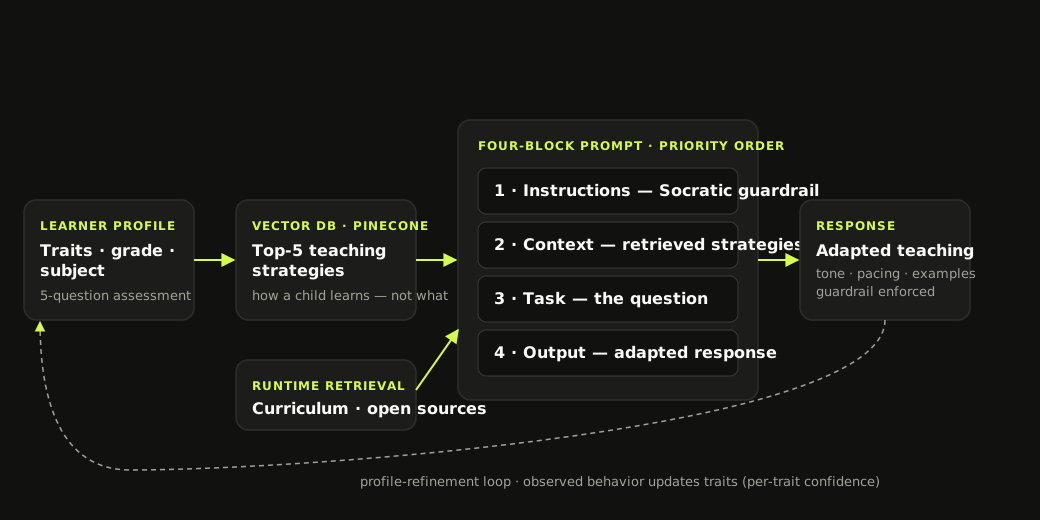
For each turn, Pinecone retrieves the top-5 teaching strategies matching the child's traits, grade, and subject. Those strategies are injected into a four-block hierarchical prompt — Instructions → Context → Task → Output — with explicit priority ordering, so the learning-style layer can shape delivery but sits below the pedagogy layer. Lesson content itself is retrieved at runtime from open educational sources, never stored.
A profile-refinement loop keeps the model of the learner honest: observed session behavior — question frequency, response to visual hints, frustration signals — updates traits alongside assessment data, with per-trait confidence tracking and a graceful fallback to general strategies when a learner is new. Because the audience is children, data handling is COPPA-aware and safety-first by default.
Tradeoffs & lessons
Links
The demo above is the recorded walkthrough; a public repo and a longer write-up of the prompt architecture are being prepared and will appear here.