3-phase verify · search → enrich → CRM
Turns hours of manual prospecting per rep into one pipeline: natural-language search → three-phase verification → AI enrichment → CRM export.
The whole point of LeadForager is to collapse the unglamorous 80% of prospecting — search, verify, enrich, export — into a single pipeline a rep can trust without hand-checking every row.
The problem
Reps waste hours per prospect on research: discovering local businesses, confirming each is real, active, and on-criteria, then transcribing the keepers into a CRM. Verification is where the time goes. A listing can look perfectly valid and still be closed, duplicated, or a poor fit — and getting that wrong pollutes the pipeline downstream.
Solution & demo
LeadForager treats the lifecycle as one flow — Results → Cold Leads → Verified → CRM — with bulk operations, CSV import and export, and subscription tiers with usage-based limits. A natural-language request parses into a structured search; candidates are verified; survivors are AI-enriched with a 0–100 score across website quality, tech gaps, business signals, and market opportunity, plus a drafted outreach email; and verified leads sync to HubSpot, Salesforce, or Pipedrive with field mapping and deduplication.

Recorded walkthrough coming soon.
In the meantime, the architecture and tradeoffs below tell the full story — or start a conversation and I'll walk you through it.
Live “Try it” demo lands in a later release. For now, the recorded walkthrough above is the demo.
How it works
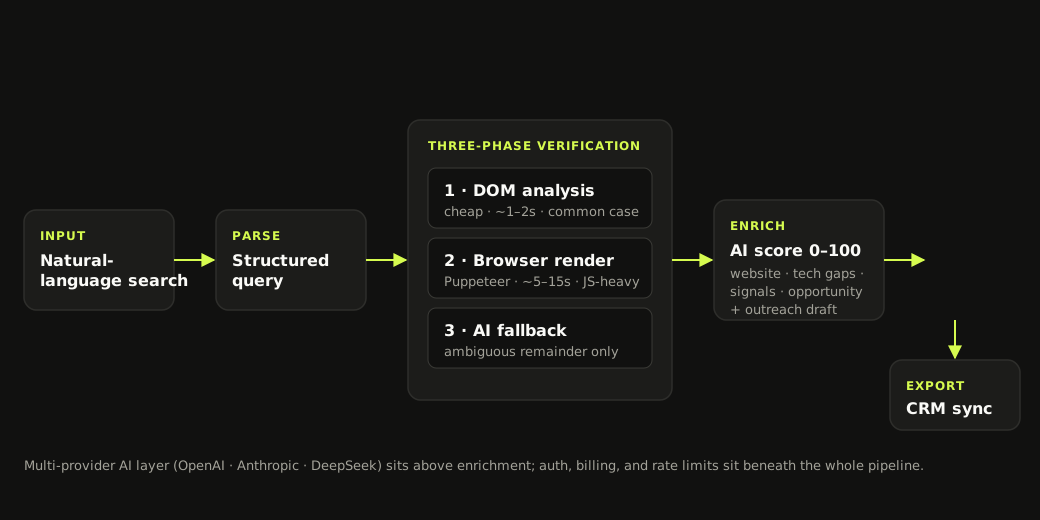
The verification engine runs in escalating tiers. Static DOM analysis (roughly 1–2s) handles the common case for almost nothing. Sites that render their content with JavaScript escalate to a Puppeteer browser render (roughly 5–15s). Only the ambiguous remainder falls through to an AI analysis pass. Criteria are weighted and configurable with confidence thresholds, and a live test harness lets you tune them against known-good and known-bad examples.
Above that sits a provider-agnostic AI layer — OpenAI, Anthropic, and DeepSeek behind one interface, with proxy-endpoint support for security and compliance — used for the enrichment scoring, the personalized outreach drafts, and an embedded assistant. Underneath is the ordinary product surface that has to be right: auth, billing, rate limits, API keys, input validation, and session management.
Tradeoffs & lessons
Links
The demo above is the recorded walkthrough; a public repo and a deeper write-up are being prepared and will appear here as they are published.