Every dollar hash-chained · reconciled daily
A production ledger where every dollar is hash-chained, double-entered, and reconciled against the bank daily — because 'the numbers are probably right' is not good enough for the IRS.
Presented as an anonymized engagement: no client name, branding, or screenshots appear anywhere on this page, and every figure below is synthetic. What follows is the engineering, not the client.
The problem
A 501(c)(3) Scholarship Granting Organization under the new IRS §25F federal tax credit has to move real money under real rules: process donations, keep each school's funds segregated, disburse directly to approved vendors, and stay audit-ready — all before a statutory effective-date deadline. When the auditor is the IRS, "the totals look about right" is a failure condition. Correctness had to be enforced by the system, not trusted to careful code.
Solution & demo
The answer is an append-only, double-entry ledger where the database — not the application — is the source of truth. Beyond the ledger, dense regulation is translated into enforceable product mechanics: a 90% expenditure ratio, anti-earmarking rules, income-based eligibility thresholds, IRS Pub 1771 receipt requirements encoded as database CHECK constraints, and a 7-year retention posture. A six-role access model (donor, parent, school, homeschool hub, admin, auditor) gives each party its own portal, and ineligible expense categories are made literally unselectable rather than merely discouraged.
Recorded walkthrough coming soon.
In the meantime, the architecture and tradeoffs below tell the full story — or start a conversation and I'll walk you through it.
Live “Try it” demo lands in a later release. For now, the recorded walkthrough above is the demo.
How it works
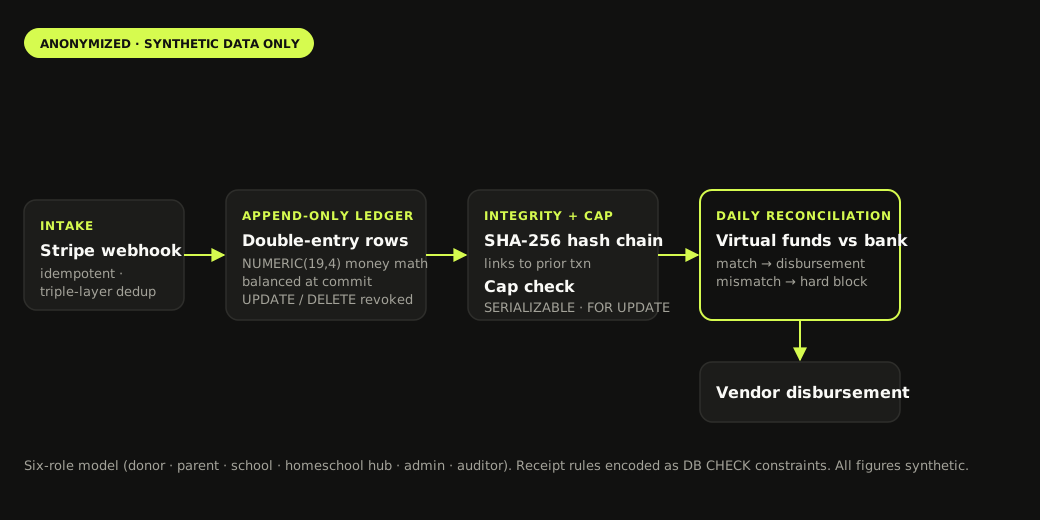
Financial correctness is treated as a first-class discipline. The ledger is append-only because UPDATE and DELETE are revoked at the database role layer, so there is no code path that can rewrite history. Every transaction carries a SHA-256 hash linking it to the prior one, so tampering is detectable. Money is decimal on NUMERIC(19,4) columns and never a float, so a rounding error cannot creep in. Deferrable constraints require debits and credits to balance at commit time. The statutory annual donation cap is enforced under SERIALIZABLE isolation with SELECT FOR UPDATE, so two concurrent donations cannot both squeak under the limit. Stripe webhooks are idempotent across three layers so a retried event is never double-counted. And a daily reconciliation job compares the virtual per-school balances against the physical bank account and hard-blocks any disbursement when they disagree.
Tradeoffs & lessons
Links
Because this is anonymized client work, there is no public repo or live link. An anonymized engineering write-up is prepared from synthetic material only; publishing it in full is gated on client sign-off, and engagement status is described generically on purpose.